In short, what is a chargeback: the reversal of a card payment that the cardholder’s bank starts after a disputed charge, pulling the money back from the merchant’s acquirer. This guide is for PSPs, acquirers and payment platforms.
What Is a Chargeback?
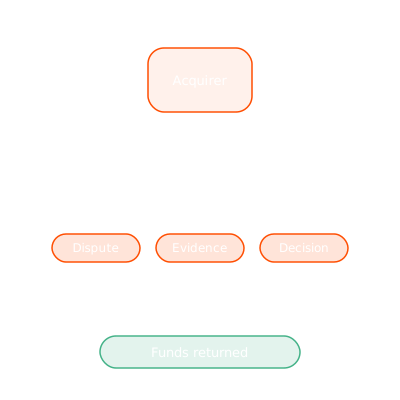
A chargeback is a forced return of a settled card payment, raised by the issuer when a cardholder’s claim fits a scheme dispute condition. The merchant may answer it with evidence. The parties and stages are set out step by step below.
Card schemes created the mechanism to protect cardholders, and it sits after authorization, clearing and settlement in the life of a payment. Our guide to payment processing software shows where it falls among the other stages. A chargeback is not a declined transaction: a decline stops a payment before money moves, while a chargeback pulls money back after the merchant has been paid.
Definition
Chargeback
The return of a card transaction from the merchant’s acquirer to the issuer, initiated by the issuer under card scheme rules after the cardholder disputes the charge. Visa calls the whole process a dispute.
The terms vary by network. The Visa Dispute Management Guide for Merchants uses “dispute” as its official word and notes that merchants also hear “chargeback”. This guide uses both, and quotes Visa rules because they are public. Mastercard and other schemes run similar cycles under their own rules and deadlines.
What Is the Difference Between a Chargeback, a Refund and a Reversal?
The difference is who starts it and when. A reversal cancels a payment before or just after it is completed, at the merchant’s request. A refund returns money the merchant agrees to give back. A chargeback is started by the issuer, often against the merchant’s will, and follows scheme deadlines and evidence rules.
Reversal, refund and chargeback compared
Operation
Who starts it
When
Merchant’s consent
Reversal
The merchant or the gateway
Before settlement, or when an approved payment is not completed
Yes
Refund
The merchant
After settlement, as a new credit to the card
Yes
Chargeback
The issuer, on the cardholder’s claim
After settlement, within scheme time limits
No
A refund issued before the dispute can stop it. Visa advises merchants to answer a complaint quickly and to issue a legitimate refund at once. Once a merchant has accepted a case through Rapid Dispute Resolution, a separate refund can create a duplicate credit, so do not refund unless the acquirer advises it. Our overview of card transaction types shows how each operation is recorded.
Who Is Involved in a Chargeback?
Five parties take part: the cardholder, who disputes the charge; the issuer, who decides whether to raise a dispute; the card scheme, which sets the rules and runs arbitration; the acquirer, who answers to the issuer; and the merchant, who supplies evidence. A PSP or gateway sits between merchant and acquirer and carries the data.
Starts the claim
Cardholder
Contacts the issuer because a charge is unknown, goods did not arrive or something went wrong.
Raises the dispute
Issuer
Checks the claim against a dispute condition and sends the transaction back through the network.
Sets the rules
Card scheme
Defines conditions, deadlines and evidence, and decides the case in arbitration.
Answers the issuer
Acquirer
Receives the dispute, debits the merchant and submits the response within the time limit.
Carries the data
PSP or gateway
Links the dispute to the original payment, notifies the merchant and collects evidence.
Supplies evidence
Merchant
Decides whether to accept or respond, and bears the loss under the merchant agreement.
Visa notes that disputes are handled between the issuer and the acquirer, who may then contact the merchant. The merchant agreement sets who does what. For a PSP that onboards merchants under its own contract, that agreement is part of merchant management, written before the first payment.
How Does a Chargeback Work, Step by Step?
A chargeback moves through fixed stages: the cardholder’s claim, the issuer’s dispute, the merchant’s response through the acquirer, a pre-arbitration round and, if the parties still disagree, arbitration by the scheme. Each stage has a deadline. A party that misses it can lose the case even with strong evidence.
The cardholder contacts the issuer
The cardholder does not recognise the charge, did not receive the goods, or was charged twice or after cancelling.
The issuer raises a dispute
The issuer checks the claim against a dispute condition and sends it through the network. The acquirer is debited.
The acquirer notifies the merchant
The acquirer, or the PSP between them, debits the merchant’s balance and passes on the dispute condition and deadline.
The merchant accepts or responds
The merchant either accepts the loss or sends evidence that answers the claim. The acquirer submits it to the issuer.
Pre-arbitration
The other side reviews the evidence and either accepts financial responsibility or continues with new information.
Arbitration
If the case is still open, the scheme decides who carries the loss.
In the Visa Core Rules and Product and Service Rules, the order of steps differs by category. For fraud and authorization disputes, the acquirer’s first answer is a pre-arbitration attempt. For processing errors and consumer disputes, the acquirer first sends a dispute response, and the issuer then makes the pre-arbitration attempt. The industry calls the merchant’s answer representment. Where a payment routing setup spreads one merchant over several acquirers, each acquirer runs its own cases.
What Are the Main Chargeback Reasons?
Visa groups dispute reasons into four categories, each with numbered conditions: fraud (10), authorization (11), processing errors (12) and consumer disputes (13). The condition tells you why the issuer raised the dispute and what evidence, if any, can answer it. It is also called a reason code.
Visa dispute categories and examples of conditions
Category
What went wrong
Example conditions
10 Fraud
The cardholder says they did not make or allow the payment
10.4 Other Fraud – Card-Absent Environment; 10.5 Visa Monitoring Programs
11 Authorization
The payment was not properly authorized
11.2 Declined Authorization; 11.3 No Authorization / Late Presentment
12 Processing errors
The payment was processed with wrong data
12.3 Incorrect Currency; 12.5 Incorrect Amount; 12.6 Duplicate Processing / Paid by Other Means
13 Consumer disputes
The cardholder is unhappy with what they bought
13.1 Merchandise/Services Not Received; 13.2 Cancelled Recurring Transaction; 13.6 Credit Not Processed
Source: Visa Dispute Management Guide for Merchants, October 2026
Category 10 holds most card-not-present claims, from stolen cards and card testing to friendly fraud, a dispute by a cardholder who did make the purchase. That is why anti-fraud rules come before dispute handling, and why friendly fraud needs evidence that links the cardholder to the payment.
Category 13 claims are usually service problems: they fall when delivery, cancellation and refund terms are clear and kept.
Visa also lists simple causes behind many disputes: wrong or missing transaction details, unclear refund policies, late delivery and a business name that customers do not recognise on their statement. A complete list of codes and their evidence is in the scheme rules.
How Long Does a Chargeback Take?
Under the Visa Rules, an issuer must raise most disputes within 120 calendar days of the transaction processing date. Each later stage then has 30 calendar days, and arbitration must be filed within 10. A case that runs every stage can take months, and a missed deadline can close it against the late party.
Visa dispute time limits by stage
Stage
Fraud and authorization (10, 11)
Processing errors and consumer disputes (12, 13)
Dispute by the issuer
Most conditions: 120 calendar days from the transaction processing date, or from a later date set by the condition
Dispute response by the acquirer
Not used: the acquirer answers with a pre-arbitration attempt
30 calendar days from the dispute processing date
Pre-arbitration attempt
Acquirer, 30 calendar days from the dispute processing date
Issuer, 30 calendar days from the dispute response processing date
Pre-arbitration response
Issuer, 30 calendar days
Acquirer, 30 calendar days
Arbitration filing
Acquirer, 10 calendar days from the pre-arbitration response
Issuer, 10 calendar days from the pre-arbitration response
Source: Visa Core Rules and Visa Product and Service Rules, 24 October 2026, Tables 11-2 and 11-3
Deadlines
The merchant’s window is shorter
The 30 days belong to the acquirer, which needs time to check and submit the evidence, so the merchant gets a shorter internal deadline. Set it in your merchant agreement and show it next to each case in your back office.
For some consumer disputes, the 120 days start later, for example on the date the cardholder expected to receive the goods. That is why you keep a reserve for some time after a merchant stops processing, as described in our merchant onboarding guide.
Illustrative example
One consumer dispute, start to finish
Assumptions: a Visa card-not-present payment processed on 1 March, a condition 13.1 claim for goods not received, every party using its full deadline, and the merchant’s evidence answering the claim.
Day
Who
What happens
0
Issuer
Raises the dispute on day 90, within the 120-day limit; the acquirer debits the merchant
+30
Acquirer
Sends the dispute response with proof of delivery
+60
Issuer
Makes a pre-arbitration attempt with the cardholder’s new statement
+90
Acquirer
Declines it with more evidence
+100
Issuer
Files for arbitration; the scheme decides
In this case the funds stay contested for more than 100 days after the dispute, and almost 200 days after the sale.
Who Pays for a Chargeback?
The merchant pays in most cases. The acquirer is liable to the issuer and the scheme, then recovers the amount from the merchant under the merchant agreement. If the merchant has closed or cannot pay, the loss stays with whoever sits above it: you, as the PSP that onboarded it, or the acquirer.
Liability can move away from the merchant. In fraud disputes, how the payment was processed often decides the result more than the evidence does. Visa’s guide lists the cases where Visa Secure, Visa’s 3-D Secure programme, gives protection from fraud-related disputes:
Protected from fraud disputes
Fully authenticated payment sent with electronic commerce indicator (ECI) 5 and a valid cardholder authentication verification value (CAVV)
Authenticated payment credential, ECI 5, with a valid token authentication verification value (TAVV)
Attempted authentication, ECI 6, with a CAVV in the issuer’s attempt response
Not protected
Payments without Visa Secure, sent with ECI 7
Attempted authentication on non-reloadable prepaid cards
Payments listed in a Visa Monitoring Program, disputed under condition 10.5
Any consumer dispute or processing error
The protection depends on data: the CAVV and every 3-D Secure element must reach the authorization request. A gateway that drops one of them loses the protection, and the loss shows only when a fraud dispute arrives. For tokenized payments, the token’s cryptogram plays the same role, which is one reason to use network tokenization.
Can a Merchant Fight a Chargeback?
Yes, when the dispute condition allows a response and the merchant has evidence that answers the claim. The response goes through the acquirer within the deadline. Visa advises that evidence should link the transaction to the cardholder, show that they took part in or benefited from it, or show it was billed as agreed.
Evidence that tends to answer a dispute
Proof of delivery or of service use, with dates
A refund or reversal already processed, with its date, amount and reference number
A dated message from the cardholder, sent after the dispute, saying they no longer dispute the payment
The terms the cardholder accepted at checkout, in the version live at that time
For card-absent fraud: earlier undisputed payments with the same card, device or IP address
Visa asks for documents that are clear, in English or with an English translation, and limited to the claim. More pages do not help. A gateway that stores transaction statistics and logs per payment makes this evidence quick to pull.
For condition 10.4, card-absent fraud, Visa’s Compelling Evidence 3.0 framework lets the merchant use at least two earlier undisputed payments with the same credential, made within 365 days before the disputed one and more than 120 days before the dispute.
Visa Rules
When a response is not worth sending
Some conditions leave almost no room. An ECI 7 card-absent fraud claim with no qualifying earlier payments for Compelling Evidence 3.0 has nothing to show. Condition 10.5 can be answered only when an earlier dispute on the same payment was already accepted. In those cases accept the loss and fix the cause.
Schemes also offer tools that end a case before it becomes a chargeback. Visa’s Order Insight shares purchase details with the issuer when a cardholder asks about a charge, and Rapid Dispute Resolution lets the merchant set rules that accept eligible disputes automatically. Accepting through Rapid Dispute Resolution already moves the funds, so a separate refund can create a duplicate credit; do not refund unless the acquirer advises it.
Why Do Chargebacks Matter to a PSP?
Because you carry them three times. You pay the merchant’s losses when the merchant cannot. Your acquirer counts the disputes of every merchant in its portfolio against scheme monitoring programs. And each case costs operations time. A few high-dispute merchants can put the whole portfolio, and the acquiring contract, at risk.
Card schemes watch dispute and fraud levels per merchant and per acquirer. Visa notes that a merchant flagged under a monitoring program can face condition 10.5 disputes even on payments authenticated with Visa Secure. Programs, thresholds and fees change, so we cover them separately from this guide.
Track the dispute ratio per merchant and act on rules before a threshold is crossed.
Operations
After a dispute
Link each case to its payment, keep the deadline visible and feed results into routing and anti-fraud.
Chargebacks with eComCharge
The eComCharge white-label payment gateway records a chargeback as its own transaction, linked to the original payment or capture. When the acquiring partner reports chargebacks by API, the platform creates the transaction automatically. When it reports them by email, your staff add it manually in the back office.
What the platform does with chargebacks
Keeps the chargeback next to the payment, refund and capture of the same order, so the full history sits in one place.
Shows the chargeback rate per merchant on FinStatHub dashboards next to approval rate and volume.
Lets you watch the chargeback ratio as a condition in Action Rules, and alert, limit traffic or blacklist when it is met.
Brings chargeback history into Smart Routing through SmartCheck signals, for antifraud and 3-D Secure decisions.
Sends refund and chargeback alerts to merchants and reconciles refunds and chargebacks at the right FX rate, as described for low-risk PSPs.
Runs 3-D Secure through its own 3DS Server and MPI, so authentication data reaches the authorization.
The same tools serve PSPs with higher dispute exposure, described on our page for iGaming and Forex PSPs.
eComCharge pricing depends on your specific needs, such as the deployment model, volume and connectors, so contact our sales team for a quote.
Frequently asked questions
A chargeback is the reversal of a card payment that the cardholder's bank, the issuer, starts after the cardholder disputes the charge. The issuer sends the transaction back through the card network to the acquirer, which debits the merchant. Visa calls the process a dispute; the industry usually says chargeback.
No. A refund is started by the merchant, who agrees to return money. A chargeback is started by the issuer on the cardholder's behalf, often without the merchant's agreement, and runs under card scheme rules with deadlines, evidence and possible arbitration. A refund issued in time can stop a dispute from becoming a chargeback.
Under the Visa Rules, an issuer must process most disputes no later than 120 calendar days from the transaction processing date. For some conditions the clock starts later, for example on the date the cardholder expected to receive the goods. Other schemes set their own limits, so check the rules of each network you process.
Yes, when the dispute condition allows a response and the merchant has evidence that answers the cardholder's claim, such as proof of delivery, a refund already issued or a cardholder's dated withdrawal. The acquirer submits the response. Some conditions, such as 10.5 Visa Monitoring Programs, give the merchant almost no right to respond.
Representment is the industry name for the merchant's answer to a chargeback, sent through the acquirer with evidence that the transaction was valid. Visa calls this step a dispute response for processing-error and consumer disputes, and a pre-arbitration attempt for fraud and authorization disputes. The issuer then accepts or continues the case.
It protects against fraud-related disputes only. Under Visa Secure, a fully authenticated transaction with ECI 5 and a valid CAVV, or an attempted authentication with ECI 6, can qualify for fraud dispute protection. ECI 7 transactions are not protected. 3-D Secure does not help with consumer disputes such as goods not received.
The acquirer is liable to the card scheme and recovers the amount from the merchant under the merchant agreement. If the merchant cannot pay, for example after closing, the loss can stay with the acquirer or the PSP that onboarded the merchant. That is why PSPs hold reserves and watch dispute ratios for each merchant.
In daily use the words mean the same thing. Visa uses dispute as its official term for the whole process, while chargeback usually means the moment the funds move back from the acquirer to the issuer. An inquiry or retrieval request before that stage is not yet a chargeback.
Respectfully, the eComCharge Team
eComCharge develops and delivers the PCI DSS Level 1 certified white-label payment platform for Payment Service Providers and Payment Orchestration.
How PSPs and acquirers process high-risk card payments: which merchants count as high risk, who carries the liability, Visa VAMP thresholds, reserves and limits, the gateway features you need, multiple acquirers and the risks.
A practitioner's guide to launching a payment service provider: choosing a model, signing an acquirer, licensing, PCI DSS, platform choice, cost drivers and a 9-step launch plan.
How PSPs, acquiring banks and EMIs onboard high-risk merchants: which MCCs count as high risk, the KYB, UBO and sanctions checks EU law requires, underwriting and reserves, Visa registration and monitoring, what to automate and how to keep an evidence trail.
How a PSP protects itself from a sudden acquirer shut-off, outage or limit change: concentration risk, scheme and underwriting triggers, backup acquirers, portable tokens, volume split, an outage runbook, costs and who does not need it.
A guide to cascading payments for PSPs and acquiring banks: soft, hard and technical declines, which Visa response codes may cascade, cascade design, duplicate-charge prevention, 3DS, scheme rules, recovery KPIs and who should not cascade.
A guide for PSPs, banks and platforms on custom payment solutions: custom build vs off-the-shelf vs white-label, what can be customised, how a connector or payout flow is scoped and delivered, what drives cost and time, and the risks.