Custom payment solutions are payment setups in which an operator adapts a platform’s connectors, checkout, routing, reports or payout logic to its own business instead of using it exactly as delivered. This guide is for PSPs, banks and platforms deciding what to customise on a white-label payment gateway.
What Are Custom Payment Solutions?
A custom payment solution is a payment stack shaped around your merchants, markets and money flows. For you as an operator, it rarely means writing a gateway from scratch. It means taking payment gateway software and changing what it connects to, how it looks and what it does with each payment.
Customisation happens at three depths, and each one has a different owner and cost driver:
Depth 1
Configuration
You change settings the platform already exposes: routing rules, fees, limits, branding and report layouts. Your own team does it in the back office.
Depth 2
Extension
The vendor adds code to its platform for you: a connector to a new acquirer, a local payment method or a new flow. You write the requirements and accept the result.
Depth 3
Own build
You develop and run the processing core yourself. Every feature is yours, and so are certification, security audits and maintenance.
A modular payment platform keeps most requests at depth 1 or 2, because modules for routing, risk, payouts and reporting already exist and only need to be switched on or extended.
The choice between the three depths is the same one you face when you pick payment processing software: how much you want to own versus how fast you need to launch.
Custom vs Off-the-Shelf vs White-Label: Which Fits?
Off-the-shelf fits when the standard product covers your merchants. A full custom build fits when payment technology is your product and you can fund years of work. White-label with customisation sits between them: you rent a working platform under your brand and order extensions only where your business differs.
Three ways to get a custom payment solution
Criteria
Off-the-shelf as delivered
White-label with customisation
Custom build in-house
Who owns the code
The vendor
The vendor; you own the configuration and your data
You
Brand your merchants see
The vendor’s or a mix
Yours: payment pages, back office, domain
Yours
New acquirer or method
Only from the vendor’s list
From the list, or developed on request
Your developers build each one
PCI DSS
Vendor validates the platform
Vendor validates the platform; you validate your own environment
You validate everything
Time to launch
Fastest
On eComCharge: from 1 week as software-as-a-service (SaaS) or from 3 months on your own servers
12 months to 2 years for a production-ready gateway (our estimate)
Fits
Few merchants, standard needs
PSPs, banks and platforms with their own acquirers and flows
Payment technology as the core product
The deployment model sets how deep you can go. A SaaS payment gateway shares one codebase across tenants, so custom code is built as a feature the vendor maintains. An on-premises payment gateway runs on your servers and gives your team direct control of the system.
To compare the options in money, run a three-year build vs buy calculation with your own salaries, audit costs and volumes.
What Can You Customise on a Payment Platform?
You can customise seven areas: connectors, payment methods, checkout, routing, fees, back office with reports, and payout logic. The table splits each area into what your team configures and what the vendor develops.
What is configuration and what is development
Area
Configuration (your team, no code)
Development (vendor, on request)
Acquirer connectors
Switch on a connector the platform already has
A connector to an acquirer or bank that is not on the list
Payment methods
Enable a method per merchant or shop
A local method new to the platform
Checkout
Logo, colours, fonts, button text, languages
A new page flow or fields the page does not support
Routing
Rules, fallback order and traffic weights
A routing input the engine does not read
Fees and limits
Fixed and percentage fees per transaction type, limits per merchant
A fee model the billing engine cannot express
Back office and reports
Report layouts, dashboards, user roles, interface styling
An export or report format for a specific system
Payouts and splits
Payout rules and recipients
A settlement flow new to the platform
Ask a vendor to sort your requirements into these two columns before any estimate. A request that lands in the first column costs you configuration time only. The second column is where scope, testing and maintenance questions start, which the rest of this guide covers.
If you run a software platform that adds payments for its own users, our SaaS payment platform guide shows which of these areas matter for embedded payments.
How Is a Custom Connector to a New Acquirer Built?
A custom connector is built in five stages: you sign with the acquirer, the acquirer hands over its integration spec and test access, the vendor develops, the acquirer certifies, and you switch traffic on. The longest wait is often the acquirer’s certification queue, not the code.
You sign with the acquirer
You agree the contract, schemes, currencies and merchant categories. The acquirer underwrites you and issues merchant IDs (MIDs).
The acquirer sends its spec
The acquirer provides its application programming interface (API) or host-to-host specification, test credentials and a test environment. Ask for the refund, reversal and 3-D Secure (3DS) message formats up front.
The vendor develops the connector
The vendor maps the acquirer’s messages to its own transaction types and response codes, including refunds and authentication through the 3DS Server.
The acquirer certifies the integration
The acquirer runs its test cases against the connector and approves it for live traffic. You book this slot early.
You route traffic to it
You add the connector to your routing rules, start with a share of one segment and compare results before moving more volume.
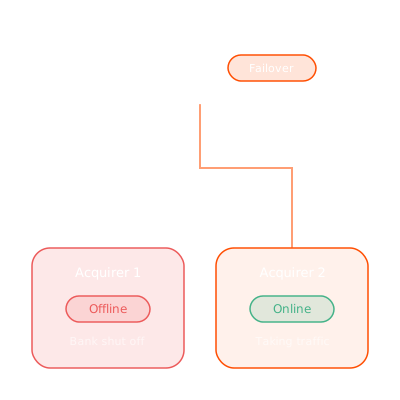
A second acquirer is rarely a technical whim. It is the core of a multi-acquirer strategy that keeps you processing when one bank shuts you off. Plan the connector before you need it.
eComCharge develops new connectors with banks and payment methods on request and typically completes at least 6 new connector integrations a month, as ordered by tenants of its white-label gateway.
How Far Can You Customise the Checkout?
You can customise the checkout as far as the integration type allows, and the integration type also sets your merchants’ PCI DSS scope. A hosted payment page or widget lets you change branding while card data stays with the gateway. A direct API gives full control of the page and moves card data into the merchant’s systems.
Checkout integration types compared
Integration
What you can change
Who handles card data
Hosted payment page
Logo, colours, fonts, languages, the payment methods shown
The gateway; the merchant redirects the buyer
Payment widget
The same as the hosted page, shown on the merchant’s site
The gateway, inside the widget
Mobile software development kits (SDKs)
The in-app payment screen
The SDK and the gateway
Direct API
Everything on the page
The merchant’s own systems, which widens its PCI DSS scope
On eComCharge, a merchant can customise the payment widget in each transaction request: font, font colour and size, background colour and the text on the pay button. The hosted payment page offers the same functions and look as the widget.
For apps, the platform provides mobile SDKs for iOS and Android.
Rule
PCI DSS and custom checkout pages
The PCI Security Standards Council describes Self-Assessment Questionnaire (SAQ) A as the questionnaire for merchants whose account data functions are completely outsourced to validated third parties. Since 31 March 2025, such a merchant must also confirm its site is not susceptible to attacks from scripts. Requirements 6.4.3 and 11.6.1 of PCI DSS v4.0.1 require payment page scripts to be authorized, checked for integrity and monitored for tampering.
Stored cards need the same care. Card tokenization in the gateway lets a custom checkout offer saved cards without the merchant holding card numbers.
Which Routing, Fee and Report Changes Need No Code?
Rules, fallback, weights, fees per transaction type, report layouts and styling are depth-1 changes. If a vendor quotes development for one of these, ask which setting its platform lacks; a new routing input, fee model or export format is where development starts.
Routing rules
In eComCharge Smart Routing you combine more than 50 conditions, such as the bank identification number (BIN), country, currency and amount, with sequential fallback and weighted distribution between connections. Rules can be set at PSP, merchant or shop level, and a rule set at the top applies to every level below it.
Automated actions
Action rules turn routine checks into automated alerts, blacklists and limits, so your risk team stops repeating them by hand.
Fees and hierarchy
Fixed and percentage fees can be set for each transaction type. The PSP, merchant and shop hierarchy is part of merchant management, with roles and permissions for each level.
Reports and styling
FinStatHub analytics gives each user a report builder, saved searches and 10+ widget types. The PSP Back Office takes 31 styling parameters, including colour and font.
When a report must feed another system, such as your ledger or an enterprise resource planning (ERP) system, the Report API serves tailored data views. Ask for that before you order a custom export, because an API call your developers write is easier to change than a file format the vendor maintains.
How Do You Customise Payout and Split Payment Logic?
Customise payout and split logic only after you settle the licensing question, because it moves money that belongs to someone else. The logic decides who receives which share of a payment, when and by which method.
Map four facts before you write a requirement. Whose account receives the acquirer’s settlement? Who calculates each party’s share and fees? Who sends the payout, and to a card, an account or a wallet? Who is liable when a chargeback arrives after the seller has been paid?
Rule
Collecting and paying out for others can be a payment service
In the EU, the second Payment Services Directive (PSD2) lists acquiring and money remittance among the payment services in its Annex I. Its Article 3(b) excludes payments through a commercial agent only where the agent acts for only the payer or only the payee. If you collect for many sellers and pay them out, check your licence before you build the flow.
On eComCharge, one payment can be split between several recipients with automated settlement and reporting, and a payout sends funds to a client’s card.
If your flow moves money person-to-person (P2P), between private individuals rather than to sellers, our P2P payment API guide covers that case.
How Is a Custom Payment Request Scoped and Delivered?
A custom payment request is scoped in writing before any code: you state the business need, the vendor sorts it into configuration and development, and both sides sign an integration spec with acceptance tests. Delivery then runs through development, your testing, any third-party certification and a controlled go-live.
You write the business requirement
Describe the merchant, the market and the money flow, with sample transactions and the reports you expect. Leave the technical design to the vendor.
The vendor runs a gap analysis
The vendor marks each item as configuration, existing module or new development, and names what it needs from third parties.
Both sides sign the integration spec
The spec lists API methods, transaction types, response codes, webhooks and the acceptance tests that will close the work.
The vendor develops and tests
Development happens in a test environment. The vendor runs its own regression tests before it hands the build to you.
You run acceptance tests
Your team replays the sample transactions, including refunds, partial refunds, declines and timeouts, and signs off.
Third parties certify
An acquirer or a payment method provider certifies its connector. A scheme certifies only what it governs, such as a 3DS Server.
You go live in stages
Start with one merchant or a share of traffic, watch approval rates and errors, then widen.
Questions to ask the vendor before you sign
Which of my requirements are configuration and which are new development?
Who maintains the custom code when the acquirer changes its API?
Will the feature be part of the standard product for every tenant, or only mine?
What test environment and sample requests do I get?
Who books and attends the acquirer’s certification?
Can I export my merchants, transactions and tokens if I leave?
What Drives the Cost and Timeline of Custom Payment Solutions?
Six things drive the cost and timeline: deployment model, the share of new development, the number of new connectors, third-party certification, data migration and dedicated infrastructure. The table says why each one moves the result and who controls it.
Cost and timeline drivers
Driver
Why it moves cost or time
Who controls it
Deployment model
SaaS starts from 1 week on eComCharge; your own servers from 3 months
You choose
Share of new development
Configuration uses only your team’s time; new code needs a spec, tests and maintenance
Vendor’s gap analysis
New connectors
Each one needs an acquirer spec, development and certification
Vendor and acquirer
Certification queue
The acquirer or method provider sets its own test slots
Third party
Data migration
Merchants, history and stored-card tokens moved from an old platform
You, the old vendor and the new one
Dedicated infrastructure
Servers reserved for you or one merchant instead of the shared pool
You choose, vendor runs it
A custom solution is worth its cost when the change earns more than it costs to maintain: more approved payments, a new market or a merchant segment you could not serve before.
Illustrative example
Scoping a payout request
Assumptions, made up for the example: you are a PSP on a SaaS platform. You add an acquirer in a new country, a local payment method and weekly payouts to sellers on one marketplace merchant.
Payouts: configuration, if the platform already supports split payments and payouts. You check the licence question first.
Local method: configuration if it is on the connector list, otherwise development on request.
New acquirer: development, followed by the acquirer’s certification, so it sets the launch date.
Routing: configuration, with a rule that sends that country’s cards to the new acquirer.
One of four items is certain development. The vendor quote should reflect that, and your plan should start with the acquirer contract.
Dedicated infrastructure is a cost line you can add later. In one of our cases, a PSP on shared SaaS solved a performance crisis with two dedicated servers for one merchant in days instead of scaling the whole platform.
How the setup, licence and transaction components fit together is described in our post on white-label gateway fees. eComCharge pricing depends strictly on your specific needs, so contact our sales team for a quote.
What Are the Risks of Custom Payment Solutions?
The risks of custom payment solutions are maintenance debt, a wider PCI DSS scope, dependence on a single vendor and launch dates set by third parties. Each grows with the share of custom code in your stack, and each has a control you can agree before the work starts.
Risks and how to reduce them
Risk
What goes wrong
How to reduce it
Maintenance debt
An acquirer changes its API or a scheme changes a rule, and nobody owns the custom code
Prefer features that join the standard product; name the maintainer in the contract
PCI DSS scope creep
A custom checkout moves card data into the merchant’s or your own systems
Keep card capture in hosted pages, widgets or SDKs and use gateway tokens
Vendor lock-in
Tokens, merchant data and routing rules cannot leave the platform
Agree data and token export terms before you sign
Third-party delays
An acquirer’s certification slot moves your launch
Sign the acquirer first and book certification early
Spec drift
Requirements change during development and the work never closes
Fix acceptance tests in the spec and order changes as a new request
Lock-in is the risk to test hardest. In one of our cases a PSP whose acquirer went offline kept its recurring base through a token migration in one week. Ask any vendor how it would do the same for you.
Outsourcing PCI DSS to a certified platform reduces your scope and does not remove it. You still validate your own environment and processes.
Customisation pays off
You have your own acquirers or plan to add them.
Your merchants need local methods, payouts or splits.
eComCharge is a white-label payment platform for PSPs, acquiring banks and platforms. You configure routing, fees, branding and reports yourself, and eComCharge develops what the platform does not have yet, starting with new connectors.
170+ active connectors with banks and payment methods, and new connectors developed on request.
Three ways to order connector work: a standard queue, overtime mode or a dedicated team for new connectors.
Hosted payment page, payment widget, mobile SDKs and 40+ e-commerce plugins.
Smart Routing with more than 50 conditions, set at PSP, merchant or shop level.
Split payments, payouts and fees per transaction type.
For banks: custom-built split payments, marketplace transaction management, merchant-specific APIs and host-to-host integration.
PCI DSS Level 1, with annual security audits since 2012.
A SaaS installation takes from 1 week and an installation on your own servers from 3 months.
Custom payment solutions are payment setups in which an operator, such as a PSP, bank or platform, adapts a payment platform's connectors, checkout, routing, reports or payout logic to its own merchants and markets. Most of the work is configuration on an existing platform. Development is added where an acquirer, a method or a money flow is missing.
There is none in practice. Bespoke payment solutions is the term more common in British English, and custom payment solutions in American English. Both describe a payment stack adapted to one operator's business, whether by configuration, by vendor development on request or by an in-house build.
Build only if payment technology is your core product and you can fund the work: we estimate 12 months to 2 years for a production-ready gateway. Otherwise, a white-label platform under your brand, with connectors and flows developed on request, covers most custom needs. On eComCharge, a SaaS installation takes from 1 week.
Yes, if the vendor builds connectors on request. You sign with the acquirer and get its integration spec and test access, the vendor develops the connector, and the acquirer certifies it before live traffic. eComCharge has 170+ active connectors and develops new ones on request.
It can. If card data is captured in a hosted payment page, widget or SDK, the gateway handles it and the merchant's scope stays small. If the merchant builds its own card form on a direct API, card data enters its systems and its PCI DSS scope grows. Since 31 March 2025, a merchant validating with Self-Assessment Questionnaire (SAQ) A must also confirm its site is not susceptible to attacks from scripts.
It is when the change earns more than it costs to run: more approved payments, a new market, or a merchant segment you could not serve before. Start with the configuration your platform already offers and order development only for what is left. Count maintenance, certification and migration as part of the cost.
It depends on your deployment model, the number of new connectors, the share of new development and any dedicated infrastructure. eComCharge pricing depends strictly on your specific needs, so contact our sales team for a quote based on your requirements.
The main risks are maintenance debt when nobody owns custom code, a wider PCI DSS scope when card data leaves the gateway, vendor lock-in when tokens and data cannot be exported, and launch dates set by an acquirer's certification. Agree the maintainer, the export terms and the certification plan before work starts.
Respectfully, the eComCharge Team
eComCharge develops and delivers the PCI DSS Level 1 certified white-label payment platform for Payment Service Providers and Payment Orchestration.
How PSPs and acquirers process high-risk card payments: which merchants count as high risk, who carries the liability, Visa VAMP thresholds, reserves and limits, the gateway features you need, multiple acquirers and the risks.
A practitioner's guide to launching a payment service provider: choosing a model, signing an acquirer, licensing, PCI DSS, platform choice, cost drivers and a 9-step launch plan.
How PSPs, acquiring banks and EMIs onboard high-risk merchants: which MCCs count as high risk, the KYB, UBO and sanctions checks EU law requires, underwriting and reserves, Visa registration and monitoring, what to automate and how to keep an evidence trail.
How a PSP protects itself from a sudden acquirer shut-off, outage or limit change: concentration risk, scheme and underwriting triggers, backup acquirers, portable tokens, volume split, an outage runbook, costs and who does not need it.
A guide to cascading payments for PSPs and acquiring banks: soft, hard and technical declines, which Visa response codes may cascade, cascade design, duplicate-charge prevention, 3DS, scheme rules, recovery KPIs and who should not cascade.
The four types of payment tokenization service provider for PSPs and banks, network vs gateway tokens, token portability and migration, PCI DSS scope, and the questions to ask before you choose.