An all in one payment gateway is one platform through which merchants accept cards, wallets and local payment methods, send payouts and get reports, over a single integration. This guide is for PSPs, acquiring banks and electronic money institutions (EMIs) that want to offer it.
What Is an All in One Payment Gateway?
It is payment gateway software that puts every acceptance and payout flow your merchants need behind one integration, one back office and one data model. The merchant connects once. You add acquirers, wallets and local methods behind that connection without asking the merchant to change code.
The alternative is a stack of separate tools. A merchant that sells in three markets may run one gateway for cards, a second provider for a local bank transfer, a payout service and a spreadsheet to reconcile them. Each piece has its own API, its own report format and its own support line.
An all in one gateway replaces that stack with one layer that you operate. It does not replace the institutions behind it: acquirers still acquire, issuers still authorize and wallet providers still run their wallets.
Separate tools vs an all in one gateway, from the merchant's side
Area
Separate tools
All in one gateway
Integration
One API per provider, each with its own error codes
One API, one hosted page, one plugin per shopping cart
Adding a method or market
A new contract and a new integration project for the merchant
You enable a connector; the merchant's integration stays the same
Acquirer outage
Payments stop until the merchant switches manually
Routing rules move traffic to a backup acquirer
Reporting
One report per provider, merged by hand
One transaction list and one set of settlement reports
"All in one" describes scope, not the business model. You can run the gateway as your own product, or rebrand it and sell it to merchants as yours: that is a white label gateway, covered in our white label guide.
What Does an All in One Payment Gateway Include?
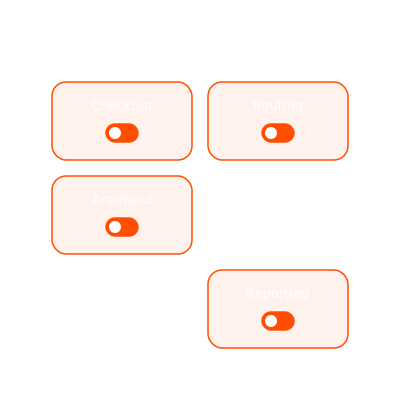
A complete one covers nine areas: payment methods, integration channels, transaction types including payouts, currencies, routing, authentication, card storage, merchant management and reconciliation. If one is missing, your merchants buy it from someone else, and you are back to a stack.
Payment methods
Three families: card schemes; Apple Pay and Google Pay, whose token for the card a card acquirer processes like a card payment; and alternative payment methods (APMs), most of which confirm the payment later by notification rather than in the first response.
Integration channels
A server-to-server API, a hosted payment page, an embedded payment widget, mobile SDKs (software development kits), payment links and e-commerce plugins for shopping carts.
Transaction types and payouts
One- and two-step payments, refunds, voids, recurring payments, payouts to cards and card-to-card transfers. Check the full list of transaction types for each connector, not only for the platform.
Multi-currency
Accepting in the shopper's currency and settling in the merchant's, with automatic currency conversion where the acquiring currency differs from the payment currency.
Routing and cascading
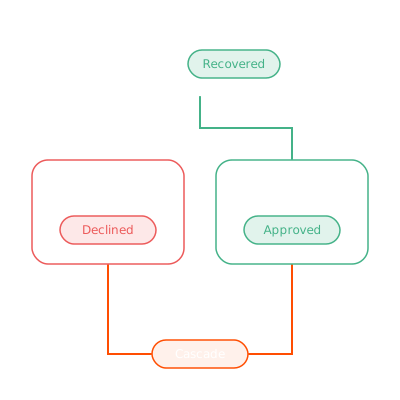
Rules that pick an acquirer by card, country, currency or amount, a backup route for outages, and cascading of declines that the scheme allows you to retry.
Risk and 3-D Secure
Anti-fraud rules, limits and blacklists, plus a 3-D Secure server (3DS Server) that runs 3-D Secure without a challenge, with a challenge or as forced authentication, by rule.
Card storage
Payment tokenization in a vault and network tokens (tokens that the card schemes issue in place of the card number), so recurring and one-click payments work on whichever acquirer the rules choose.
Merchant management
Onboarding, shops, fees, limits, balances and user roles in one back office, with rules that you set once for all merchants or per merchant.
Reporting and reconciliation
One transaction search across every method, settlement reports per acquirer and reconciliation of your records against bank statements.
Payouts deserve a separate test. Accepting a payment and paying money out use different connectors and sometimes different providers. Check that payouts appear in the same reconciliation reports as incoming payments.
What Does an All in One Gateway Not Include?
It does not include acquiring, a licence, merchant due diligence or the liability that comes with them. A gateway moves payment messages and data. Contracts, regulatory permission and the funds sit with you, your acquirers and your payment method providers.
What sits outside the gateway, and who owns it
Outside the gateway
Who owns it
What the gateway does for it
Acquiring
The acquirer: a bank or licensed institution that signs the merchant, submits transactions to the scheme and settles funds
The acquirer or provider pays out to the merchant, or to you if you collect funds
Calculates fees and balances, records settlements
Chargebacks and fraud losses
You and your acquirer, by contract
Records disputes and supplies transaction evidence
EU rule
Holding funds changes your status
In the EU, the second Payment Services Directive (PSD2) does not apply to technical service providers under Article 3(j): those that support payment services without at any time holding the funds. Acquiring is a payment service under Annex I. A payment institution that acquires needs initial capital of at least EUR 125,000 (Article 7).
The practical test is your fund flow. If acquirers settle straight to merchants, you run a technical gateway and your partners hold the licences. If merchant money passes through your accounts, you need your own licence or a licensed partner. Our post on payment service licences describes the options.
Liability follows the contracts, not the software. Our guide to white label card processing explains chargeback liability by model, and the guide to automating high-risk merchant onboarding covers the due diligence side.
How Does One Integration Reach Many Providers?
The gateway translates. The merchant sends every payment in one format; the gateway picks a connector, converts the request into that provider's format and converts the answer back. Each step has an owner, and the merchant's code does not change when you add a provider.
The merchant sends one request
Owner: the merchant. Its checkout calls your API, or the shopper pays on your hosted page or widget. The request carries the amount, the currency, the shop identifier and the method the shopper chose.
The gateway checks risk and authentication
Owner: you, through gateway rules. Limits and anti-fraud rules run first. Where strong customer authentication applies, as it does to electronic payments under Article 97 of PSD2, the 3DS Server hands the shopper to the issuer.
Routing picks a connector
Owner: you set the rules, the gateway applies them. On eComCharge, Smart Routing reads conditions such as the bank identification number (BIN), country, currency, amount and card type, and names a fallback route.
The provider processes the payment
Owner: the acquirer or the method provider. For a card, the acquirer sends the authorization through the scheme and the issuer approves or declines it. For an APM, the provider runs its own flow, often a redirect to the shopper's bank or wallet.
The gateway returns one answer
Owner: the gateway. It maps the provider's response code to one status the merchant understands, notifies the merchant by webhook and records the transaction.
Settlement and reconciliation
Owner: the acquirer or provider settles; you reconcile. Each provider sends its own settlement report. The gateway matches them against its records, so you see fees, refunds and chargebacks per merchant.
The weak point is step 5. Every provider has its own decline codes and statuses, and a gateway that maps them loosely gives merchants vague errors. Ask how decline reasons appear in the merchant's transaction statistics for each connector.
All in One Gateway vs Multiple Payment Providers
One gateway gives your merchants one integration and gives you one place to control routing, risk and reports. Several providers side by side give each merchant the strongest specialist per method, at the cost of more integrations, more reports and no shared routing. An orchestration layer on top of several gateways sits in between.
Three ways to give merchants many methods
Criteria
All in one gateway
Several providers per merchant
Orchestration layer over several gateways
Merchant integrations
One
One per provider
One, to the orchestration layer
Who holds the acquirer connections
The gateway, under your contracts
Each provider, under its own contracts
The underlying gateways
Routing across acquirers
Native, in one rules engine
None; the merchant chooses per checkout
Across gateways, not inside them
Card tokens
One vault for all routes
Separate per provider
Depends on the layer's own vault
Reconciliation
One set of reports
One report per provider
Merged by the layer, from several sources
Main risk
Dependence on one platform
Operational load and fragmented data
An extra layer and an extra vendor
Orchestration and an all in one gateway overlap: both route and both normalize responses. The difference is that the gateway connects to acquirers itself, while payment orchestration usually connects to other gateways. Our post on orchestration vs traditional gateways covers when high-risk operators choose each.
How Do You Check an All in One Gateway's Coverage by Market?
Check five things for every market your merchants sell into: a live connector for each method shoppers there use, an acquirer allowed to acquire for merchants located there, settlement in the right currency, the local authentication rules, and payouts to local cards or accounts. A connector list that says "global" answers none of them.
Coverage checks for one market
Check
What to ask
Why it matters
Acquirer jurisdiction
Which connected acquirer may acquire for a merchant located in that country?
Under Visa Core Rules 1.5.1.1, an acquirer accepts transactions only from merchant outlets in its country of domicile, unless an exception applies, such as EU passporting: using a licence from one EU country in another.
Local methods
Which domestic methods are live connectors today, and which are only on a roadmap?
A method on a roadmap does not take payments; ask for the live list for the market.
Currencies
Which currencies can the merchant accept, and which can each acquirer settle in?
Accepting in one currency and settling in another adds a conversion step and its fee.
Authentication
Does the 3DS setup meet the local strong customer authentication rule?
In the EU, PSD2 requires it for electronic payments the payer initiates.
Payouts
Can merchants pay out to cards or accounts in that country through a connector?
Marketplaces and gaming merchants need payouts as much as payments.
Illustrative example
Mapping coverage for three markets
Assumptions: you are a PSP with 40 merchants. They sell into market A (your home market in the EU), market B (another EU country) and market C (outside the EU). Shoppers in each market use cards plus one domestic method. The markets and counts are invented for the example.
Market A: your home acquirer covers cards; the domestic method is a live connector. Covered.
Market B: your acquirer has passported its licence, so it can acquire for merchants located there. The domestic method needs a new connector. Partly covered: order the connector.
Market C: no connected acquirer is domiciled there, so merchants located in C need a local acquiring contract. The gateway can connect to it, but you have to sign it. Not covered until you do.
Result: one gateway, but three different answers. The software is the same in all three; the contracts are not.
If you are a bank with a domestic acquiring licence, the question runs the other way: your acquiring covers home merchants, and the gateway adds methods and markets. See how this works for European banks.
What Are the Risks of an All in One Payment Gateway?
The main risk is concentration: every method, merchant and token sits on one platform. Four risks follow from that, and each has a fix in the contract, the architecture or your routing rules.
Risks and how to reduce them
Risk
Why it matters
How to reduce it
Platform outage
If the gateway stops, all methods stop at once.
Ask for the uptime commitment in the service level agreement (SLA), the failover design and an incident history.
Lock-in
Merchants, tokens and history live on one platform.
Agree data export and token migration terms before you sign.
Breadth over depth
A long connector list can hide connectors with few transaction types.
Test refunds, payouts and recurring payments on each connector you plan to use.
Assumed compliance
The platform's PCI DSS certificate does not cover your systems or staff.
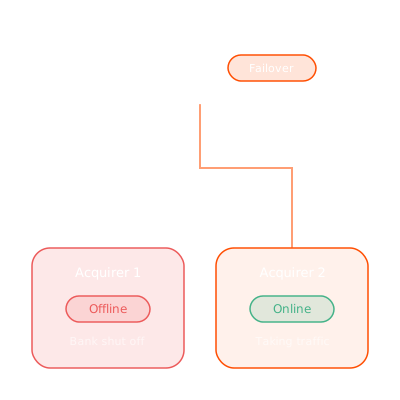
Putting every method on one gateway does not spread your acquiring risk. If all card traffic still goes to one acquirer, an outage or a shut-off at that acquirer stops your card business. Hold at least two routes and a fallback rule for the markets that carry your volume; see an acquirer failure contained in seconds. Our multi-acquirer strategy guide shows how to set up the second route.
Who Does Not Need an All in One Payment Gateway?
You do not need one if your merchants sell in one country, take cards through one acquirer and need no payouts. A standard gateway connection does that job. The case for all in one starts when a second market, a second acquirer or a payout flow appears.
A fit
Merchants sell into two or more countries with different local methods.
You hold, or plan, two or more acquiring contracts and want to route between them.
Merchants need payouts, refunds and recurring payments on the same integration.
You need one reconciliation across every provider.
Not a fit
One country, one acquirer, cards only: a single connector does the job.
A single merchant selling its own goods: a merchant account with a PSP is simpler.
You want referral income only: refer merchants to an existing gateway.
You cannot staff risk and support for many methods yet: start with one acquirer and add methods later.
If you run a software platform and payments are one feature of your product rather than the product, read how a SaaS payment platform (software as a service) embeds them.
How Do You Choose an All in One Payment Gateway?
Start from your merchants, not from the vendor's feature list. Write down where they sell, which methods and payouts they need and which acquirers you hold, then test each vendor against that list. Six steps take you from the list to a decision.
Map demand
List your merchants' markets, methods, currencies and payout needs, with the share of volume each one carries.
Ask for live connectors
Ask the vendor for live connectors in those markets, with transaction types per connector. Ask how new connectors are added and who pays for them.
Check your acquirers
Confirm that your current acquirers are already connected, or how long their connection would take.
Test the full cycle
In a sandbox, run a payment, a refund, a payout and a chargeback on each key connector, and find each one in the reconciliation report.
Test routing and failover
Switch off a route in testing and watch the traffic move. Check that rules can be set for all merchants and for a single merchant.
Agree exit terms
Get data export, token migration and the PCI DSS responsibility split in the contract.
How an operator earns on a gateway, what it spends and how to plan one.
An All in One Payment Gateway with eComCharge
eComCharge develops a white label payment gateway for PSPs, acquiring banks and payment institutions that serve online merchants. It covers acceptance, payouts, routing, authentication and reconciliation in one platform, on SaaS (installation from 1 week) or on your own servers (from 3 months).
What the platform includes
170+ active connectors to acquirers, PSPs and alternative payment methods; new connectors are developed on request.
Cards, Apple Pay, Google Pay and Samsung Pay, and 45+ currencies with automatic currency conversion.
Hosted payment page, payment widget, mobile SDKs, payment links, server-to-server API and 40+ e-commerce plugins.
12 transaction types, including payouts to cards, refunds, chargebacks and card-to-card transfers.
Smart Routing with 50+ routing conditions and fallback, and SmartCheck with 16 metrics per card over 360 days.
3DS Server certified by Visa, Mastercard and UnionPay; a token vault, Visa Token Service and Mastercard Secure Card on File.
PCI DSS Level 1 with annual security audits since 2012, and 24/7 technical support.
eComCharge pricing depends on your specific needs, such as the deployment model, volume and connectors, so contact our sales team for a quote, and see the full feature set of our white-label payment gateway.
Frequently asked questions
It is a payment gateway that puts card, wallet and local payment method acceptance, payouts, multi-currency, routing, 3-D Secure and reconciliation behind one integration. Merchants connect once through an API, a hosted page or a plugin, and you add acquirers and methods behind that connection.
The terms are used for the same thing. Gateway stresses the technical layer that receives and routes payments; platform usually adds the back office around it: merchant management, fees, balances and reports. When you compare offers, check the scope item by item instead of relying on the name.
Card schemes, wallets such as Apple Pay and Google Pay, and alternative payment methods like local bank transfers and instant payments, each through a connector to the provider that runs it. What matters is which connectors are live in the markets your merchants sell into, not the length of the global list.
No. The gateway connects to acquirers and routes payments to them, but the acquirer is a separate bank or licensed institution that signs the merchant and settles the funds. You still need acquiring contracts, and if merchant funds pass through your accounts, your own licence or a licensed partner.
It is better when your merchants sell in several markets or need several methods and payouts, because they integrate once and you route, report and reconcile in one place. Several dedicated providers can suit one merchant with one specialist need, at the cost of more integrations and separate reports.
Yes. A white label payment gateway is an all in one gateway that you rebrand and sell to merchants as your own, with your payment page, back office and domain. Our white label payment gateway guide explains how that model works.
Ask five questions for that country: which local methods are live connectors today, which connected acquirer may acquire for merchants located there, which settlement currencies each acquirer supports, how the 3-D Secure setup meets local authentication rules, and whether merchants can pay out to local cards or accounts. Then run a test payment, refund and payout.
It depends on the deployment model, your volume, the connectors you need and the customisation. eComCharge pricing depends strictly on your specific needs, so contact our sales team for a quote. Budget separately for acquiring contracts, licensing and your own risk and support staff.
Respectfully, the eComCharge Team
eComCharge develops and delivers the PCI DSS Level 1 certified white-label payment platform for Payment Service Providers and Payment Orchestration.
How PSPs and acquirers process high-risk card payments: which merchants count as high risk, who carries the liability, Visa VAMP thresholds, reserves and limits, the gateway features you need, multiple acquirers and the risks.
A practitioner's guide to launching a payment service provider: choosing a model, signing an acquirer, licensing, PCI DSS, platform choice, cost drivers and a 9-step launch plan.
How PSPs, acquiring banks and EMIs onboard high-risk merchants: which MCCs count as high risk, the KYB, UBO and sanctions checks EU law requires, underwriting and reserves, Visa registration and monitoring, what to automate and how to keep an evidence trail.
How a PSP protects itself from a sudden acquirer shut-off, outage or limit change: concentration risk, scheme and underwriting triggers, backup acquirers, portable tokens, volume split, an outage runbook, costs and who does not need it.
A guide to cascading payments for PSPs and acquiring banks: soft, hard and technical declines, which Visa response codes may cascade, cascade design, duplicate-charge prevention, 3DS, scheme rules, recovery KPIs and who should not cascade.
A guide for PSPs, banks and platforms on custom payment solutions: custom build vs off-the-shelf vs white-label, what can be customised, how a connector or payout flow is scoped and delivered, what drives cost and time, and the risks.