When a cardholder disputes a payment, the merchant loses more than the sale. The disputed amount is pulled back, and a separate chargeback fee lands on the merchant statement, often whether or not the merchant goes on to win the dispute. This post explains what that fee is, who sets it, and what drives the real cost of a chargeback.
Key points
- A chargeback fee is an administrative charge from the merchant's acquirer or PSP for handling a dispute. It is separate from the reversed transaction amount.
- The amount is set in the merchant's acquiring contract, not by a public scheme price list, so it varies between providers and risk profiles.
- It is usually charged per dispute and is often not refunded when the merchant wins.
- The cheapest chargeback is the one that never happens: prevention and early resolution beat winning disputes.
What a chargeback fee is
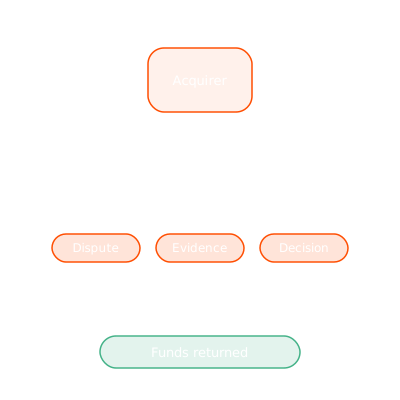
A chargeback is a forced reversal of a card payment, started by the cardholder's issuing bank under card scheme rules. If you need the full mechanics, start with our guide to what a chargeback is. The fee is what the acquirer charges the merchant for processing that reversal: receiving the dispute from the scheme, notifying the merchant, moving funds, and handling any evidence the merchant submits.
Acquirers do real work on each dispute and pay scheme-level costs themselves, so they pass a fixed charge down the chain. If the merchant is onboarded through a payment facilitator or PSP, that intermediary may add its own handling fee on top.
The full cost of one chargeback
The fee is only one line. A single dispute typically costs the merchant:
| Cost | What it is |
|---|
| Transaction amount | Debited from the merchant while the dispute runs; returned only if the merchant wins |
| Chargeback fee | Per-dispute handling charge from the acquirer or PSP |
| Goods and fulfilment | Products already shipped or services already delivered are rarely recovered |
| Operational time | Staff time to gather evidence and respond within scheme deadlines |
| Scheme programme exposure | High dispute ratios can place a merchant or its acquirer in a scheme monitoring programme, with remediation requirements and fines |
| Account risk | Acquirers may add a rolling reserve, raise pricing or terminate the account |
That last pair is where small fees turn into big problems. Visa's acquirer monitoring programme, for example, counts disputes together with reported fraud. See our explainer on Visa VAMP for how that ratio is calculated.
Why you pay even when you win
Merchants are often surprised that winning a dispute does not cancel the fee. The reason is that the fee pays for the handling, not for the outcome: the acquirer did the same work either way. Some contracts do refund the fee on a won case, and some charge an additional fee for the second stage of the dispute (pre-arbitration or arbitration), so read the fee schedule carefully. If you contest the dispute, the process is called representment.
What drives the fee up
- Risk category. Merchants in sectors with higher dispute rates (subscriptions, travel, digital goods, gaming) generally negotiate worse terms. Our high-risk payment processing guide covers how acquirers price that risk.
- Dispute ratio. Contracts often include tiers or penalties once disputes exceed a share of transactions.
- Number of intermediaries. Each party between the merchant and the scheme may add a handling charge.
- Dispute stage. Later stages, especially arbitration, carry higher costs.
How to reduce chargeback costs
1. Stop disputes before they start
A clear billing descriptor, visible customer support contacts, honest product descriptions and easy cancellation for subscriptions remove the most common reasons cardholders call their bank instead of the merchant.
2. Refund early when it makes sense
If a customer complains and the claim is likely valid, a voluntary refund costs the transaction amount but no chargeback fee, and it does not count towards dispute ratios.
3. Use scheme pre-dispute tools
Card schemes offer pre-dispute and dispute-resolution services through acquirers. Under Visa's monitoring programme, disputes resolved through pre-dispute solutions are excluded from the ratio, according to Visa's VAMP fact sheet. Ask your acquirer what is available for your portfolio.
4. Authenticate risky transactions
3-D Secure authentication shifts liability for many fraud-coded disputes to the issuer. Applying it selectively, based on risk, balances protection with conversion.
5. Fight the disputes you can win
Not every case is worth contesting. Prioritise disputes where you hold strong evidence (delivery confirmation, usage logs, signed terms) and accept the rest. Our chargeback management guide explains how to build that process.
Questions to ask your acquirer
- What is the fee per chargeback, and is it refunded if I win?
- Are there separate fees for pre-arbitration and arbitration?
- At what dispute ratio do penalties, reserves or reviews start?
- Which pre-dispute tools can I use, and what do they cost?
- How quickly will I be notified, and how long do I have to respond?
The answers tell you the real price of a dispute in your contract, and where the cheapest improvements are.
Sources