White Label
Automate High-Risk Onboarding: Streamline Risky Processes
Learn the best practices to automate high-risk onboarding, reduce security risks, and ensure a smooth, compliant onboarding experience.


A ready-to-use white-label payment processing solution under your brand

The ultimate white-label payment gateway for low-risk PSPs

Built for high-risk. Tuned for higher approval rates. Fully branded as yours.
Learn the best practices to automate high-risk onboarding, reduce security risks, and ensure a smooth, compliant onboarding experience.

Payment platforms rarely become complex all at once.
At first, everything looks fairly simple: a few acquirers, basic routing, standard reports. But as a PSP grows, the system starts accumulating new layers — users, roles, reporting, liquidity control, new payment channels. And at some point, it's precisely these internal mechanisms that determine how manageable the platform remains.
In February, we shipped several updates that touch exactly these "inner layers" of the system — payout control, access management, reporting automation, and new integrations. Here's a quick overview of each.
The platform has long had a payout control service. It allows PSPs to set payout limits for merchants — by specific acquirer and currency.
Now merchants can retrieve their available payout amount via API. The request includes a gateway identifier, and the system returns the current limit.
In practice, this allows merchants to automatically check available payout volume before initiating an operation. For large merchants and integrated systems, this makes working with the PSP payout service more predictable.
We've added a new setting for merchant employees — access to store authorization data.
By default, the store's public and secret keys are now hidden from merchant employees. If a specific user genuinely needs that access, an administrator can enable it manually in the settings.
This is especially relevant for teams where some employees handle operations or support but have nothing to do with technical integration. Access to keys is now granted deliberately — not handed out by default to everyone with a login.
WLS has long had a mechanism for automatically removing inactive users.
On the first day of each month, the system automatically deletes users who haven't logged in for more than 180 days. This rule now applies to users with the Administration role as well — previously they were an exception.
Additionally, if an account was created more than 180 days ago but the user has never logged in, it is also automatically deleted.
In large projects, the number of users grows very quickly. Mechanisms like this help maintain order and system security.
We've added new routes to the DWH API for automated report retrieval.
The process now has two steps: request a report, then retrieve a link to the ready file. Reports are available in CSV or XLSX format.
For now, one report type is available this way — balance records, an export of balance entries (the equivalent of the Export button in the Accounting → Balance v2 section). Documentation for both new routes is available in PSP docs.
For PSPs building their own analytics or accounting processes around the platform, this makes data retrieval fully automatable.
One more update — the ability to set a negative multiplier in the currency converter settings.
The actual rate is calculated based on the source rate with the configured multiplier applied. If the value is negative, the resulting rate will be lower than the source. For example, for the same amount of EUR, the buyer receives less USD — and that difference is the exchange point's margin.
In practice, this is useful for merchants who effectively act as exchange points and build their margin into the currency conversion. This scenario is common when a buyer is topping up a balance inside the merchant's system rather than making a straightforward purchase.
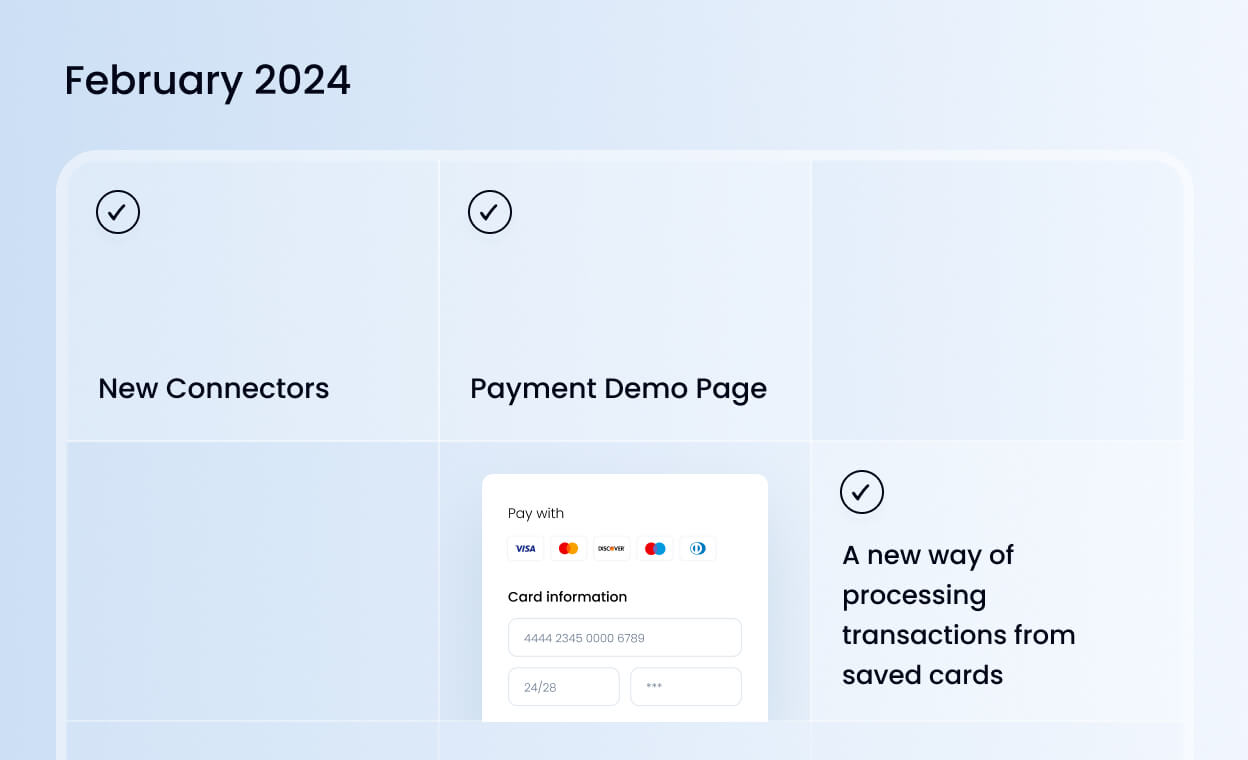
Beyond the internal changes, we continue expanding our list of payment integrations. For PSPs, this is always a critical part of the infrastructure: new markets, new local payment methods, additional channels for traffic routing.
| Provider | Type & Region |
|---|---|
| Payyd | Bank transfers in Uruguay |
| PAYOK | UPI payments in India |
| Finera | Alternative payment methods (including Google Pay and Apple Pay alternatives) |
| Sola and IZY Payments | Bank transfers in Europe |
| SlickPay | Alternative payment methods in Algeria (deeplink, credit card alternative) |
We also added several new card integrations supporting the major card networks (Visa and Mastercard) and in some cases additional schemes:
For PSPs, this means more options for building a resilient acquiring infrastructure and routing card traffic.
Looking at these updates together, a pattern emerges.
Most of them aren't about bold new features. They're about manageability: payout control, access management, clean user accounts, automated reporting, flexible currency logic. It's exactly these mechanisms that gradually turn a payment platform from a set of features into a resilient infrastructure — especially when a PSP starts operating at serious volumes.
"February updates are about manageability. Not about what's been added to the screen, but about how the system behaves internally: who sees what, who gets removed automatically, what data arrives without human involvement. A platform becomes infrastructure precisely when these things work on their own."